February 2026
Online Class For Educators Looking For Answers
We know that educators today are under more stress then maybe any other time in America’s history. Yet America’s youth have never needed educators who care and won’t give up on them more!
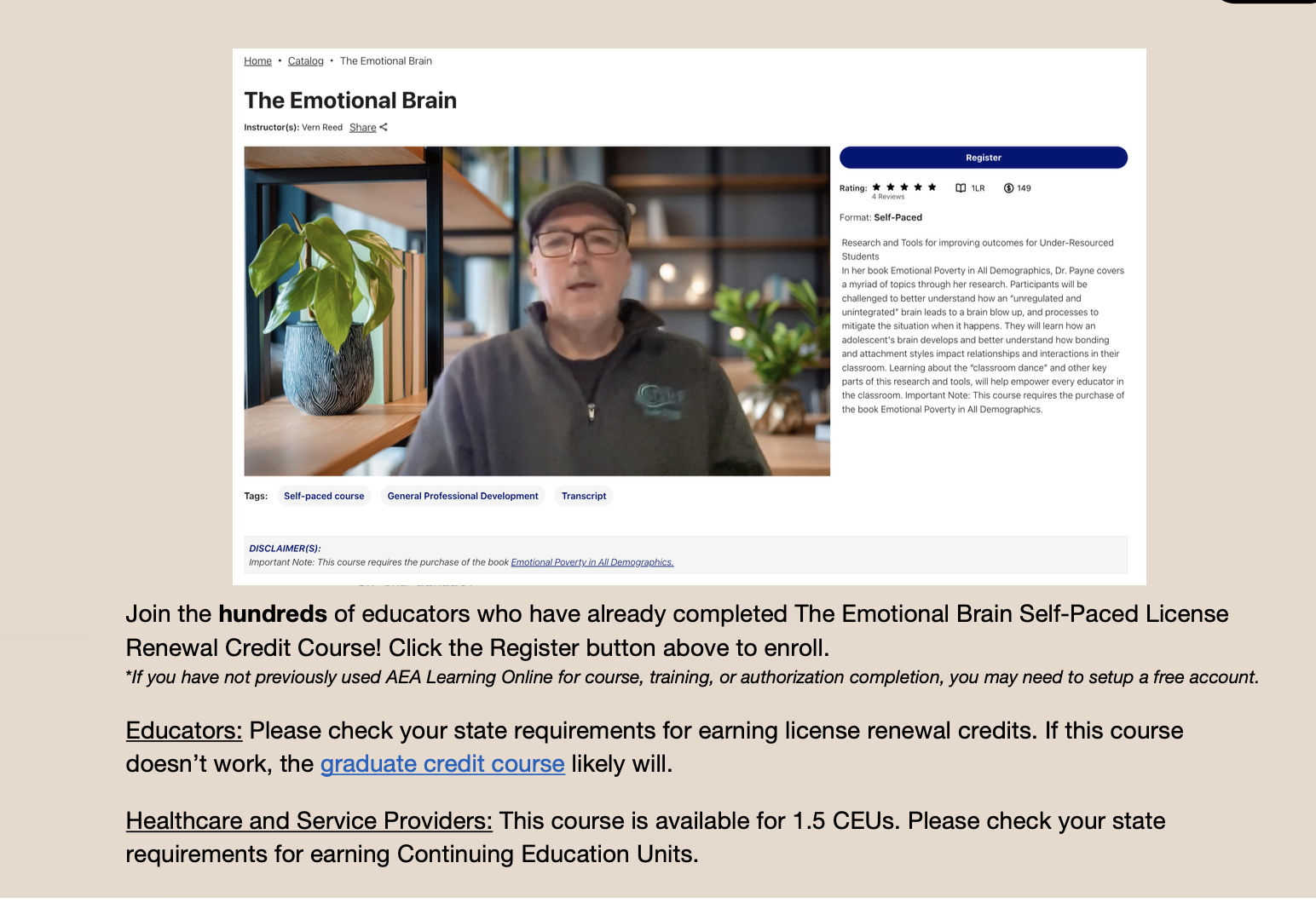
With that said, offering recertification classes that can directly impact classrooms, students and teachers alike is vital! We are hoping “The Emotional Brain” an online class offered for both recertification and CEU credits can help.
The class focuses on things teachers know, like no learning can happen when the emotional brain takes control, while offering the research and tools to impact that fact. The idea behind the class is “how can we help teachers, without adding to a teachers already very full Plate?”
While the class is offered through Iowa AEA Online learning, odds are most states will accept the class as an avenue for their educators to get the ongoing credit they need.
If you have any questions, please shoot me an email. This learning not only helped me help under-resourced students, it changed me as a human:)
January, 2025Blow-ups are not personal, and using the adult voice can transform a classroom!

As educators recently returned to the classroom after the holiday break, I want to share two things from Dr. Ruby Payne’s work.
In my experience as an “at-risk dude,”these two ideas were a huge piece of my ability to build relationships with under-resourced students, while also helping empower each to write their own “future story.”
They are also tools/processes that an educator can begin implementing as a part of their “teacher DNA” immediately, while seeing positive results from the get-go! When we accept that a “blow-up” is a brain issue, we can stop taking the blow-up personally!
In Emotional Poverty in All Demographics, Dr. Payne goes into great detail regarding “limbic lava,” the term she uses to describe what happens when the emotional brain reacts and leads to an emotional explosion. There is no question that when an under-resourced student, living in toxic stress, has an emotional explosion, it is a brain situation; but too often in education, we treat it as a behavior situation.
Understanding that fact allows me, as an educator, to quit taking the “reaction” personally! Instead of being triggered, we can utilize the learning and tools from Emotional Poverty to deescalate the situation and get to the root of the reaction.
In doing so, we create a teachable moment that does not sever a relationship and empowers the student to start building his or her emotional resources. This understanding is a gamechanger for educators and students alike, and all educators need to be trained in how to use this research.
More about “triggers”: The Power of Voice!
While Dr. Payne doesn’t talk about “voice” specifically in her Emotional Poverty series, she talks about our “three voices” in a number of her writings, and it fits easily into her Emotional Poverty work about triggers.
I referenced this idea in my first blog. In education, the reality is that so many of us use the “parent voice,” which is in itself a major trigger for any under-resourced student whose amygdala may be hypersensitive. When teachers use the parent voice, it is like they are living as a “hammer” and each student reaction they don’t understand becomes a “nail.”
We have a choice; we can choose to use the “adult” voice instead, and we can decide to only use our parent voice when absolutely necessary. The adult voice is quite simply the way we want our principal or supervisor to talk with us, even in situations when they are utilizing their “superior” positions. It is the language of choice, and it empowers a young person to not be triggered, to not react, and, most importantly, to see the educator as someone who both understands and cares!
The irony is that sometimes in education we are forced to feel like we have to be in “power” when the reality is our job is to “empower” our students. Have you ever noticed that teachers with the best classroom management are typically teachers who don’t really have to raise their voice in frustration very much?
It is impossible to overstate how much this learning from Dr. Payne’s work improved my ability to not unnecessarily “trigger” a student and empower me to build positive relationships with just about any young person! To no small degree, this learning made classroom management much easier.